
Distribution Is Not Presentation: What the Listing Wars Mean for St. Louis Agents and Brokers in 2026
Published by Home Frame Pro | April 2026 | Category: Blog
Quick Answer: In the last ninety days, every major player in American real estate has announced infrastructure to control where listings live before they hit the MLS. Compass absorbed 340,000 agents. Zillow launched Preview. eXp syndicated Coming Soon listings to three portals simultaneously. Howard Hanna built HannaList. The platforms are winning the distribution war. What none of them are solving — and what every St. Louis agent and broker needs to understand before their next listing appointment — is what happens to the listing itself when it gets there.
From the field: We are going to say something that most media companies in this position would not say. In the last ninety days, Home Frame Pro has lost clients to preferred vendor programs. Agents we worked with, whose listings we helped sell faster and at stronger prices, joined brokerage platforms that came with approved vendor lists and volume pricing. We watched it happen. We know what the listings looked like afterward. We are writing this post because what we saw is exactly what St. Louis agents and brokers need to understand before they make the same decision — and because nobody writing about this consolidation from the outside has the standing to say what we are about to say.
What is the difference between listing distribution and listing presentation — and why do St. Louis brokers need to understand both right now?
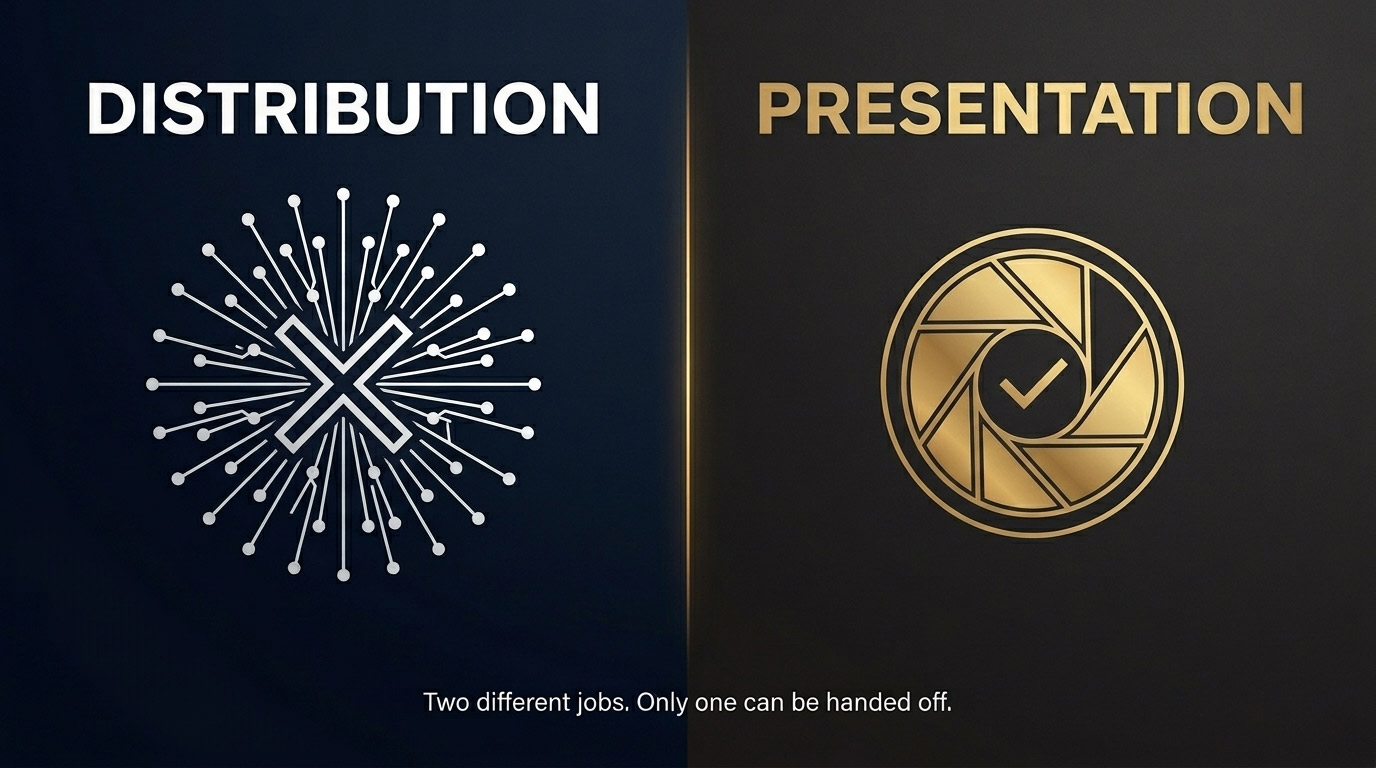
Distribution is where your listing appears. Presentation is what buyers see when it gets there. Every platform announcement in the last thirty days is about distribution. Not one of them guarantees presentation.
This distinction sounds simple. In practice it is the most important thing happening in residential real estate right now — and the agents and brokers who conflate the two are about to make a very expensive mistake.
Zillow Preview requires a participating listing to have at least one photo, a full address, property specifications, a listing description, and a price. One photo. That is the floor Zillow set for a listing to enter a platform that reaches 235 million monthly unique users. The platform handles the reach. What the listing looks like when it arrives is entirely up to whoever shot it, edited it, and decided what the floor was worth paying for.
eXp’s three-portal Coming Soon syndication reaches a combined 170 million monthly viewers across Realtor.com, Homes.com, and ComeHome.com. The listings that populate that reach are only as good as the media that went into them. The platform amplifies whatever you give it. It does not improve it.
The Compass three-phase marketing strategy — Private Exclusive, Coming Soon, Active — is genuinely sophisticated distribution infrastructure. A Clayton or Ladue listing moving through that pipeline still needs photography that stops a buyer at 11pm, a floor plan that answers the layout question before it costs a showing, and a twilight exterior that communicates curb appeal before anyone schedules a visit. The pipeline delivers reach. It does not deliver those things.
Distribution gets your listing seen. Presentation determines what happens next. These are two different jobs. The consolidation happening right now is solving the first one at scale. The second one is still entirely on you.
The takeaway for St. Louis agents and brokers is: The platform handles the reach. You handle the story. In a market where every major brokerage is building distribution infrastructure, the listing that wins is still the one that communicates livability, quality, and value most clearly — regardless of which pipeline it travels through.
When a consolidated platform controls the buyer traffic, what happens to the independent broker who isn’t part of it?
This is the question nobody writing about the distribution war is asking loudly enough — because the answer is uncomfortable for everyone except the platforms themselves.
When Zillow Preview launched on March 17, 2026, five major brokerages announced participation: Keller Williams, REMAX, HomeServices of America, Side, and United Real Estate. Eight days later, 24 additional brokerages had signed on — including Berkshire Hathaway HomeServices and Engel and Volkers. The signal from the industry, as Zillow’s own CEO described it, was undeniable.
What that signal means for brokerages and independent agents who are not part of it is more complicated than the press releases suggest.
Serious, pre-qualified buyers — the ones who have talked to a lender, know their number, and are ready to move — are increasingly discovering listings through pre-market feeds before those listings hit the open MLS. A Zillow Preview listing gets elevated placement in search results and saved-home alerts during the preview period. An eXp Coming Soon listing reaches 170 million monthly viewers across three portals before it goes active. A Compass Private Exclusive is already in front of 340,000 agents and their clients before the general public sees it.
The buyer who finds a home they love in the pre-market window is a motivated buyer. They arrived early, they saw it before the competition did, and they are emotionally invested before the listing even goes active. That buyer is exactly who every agent and broker wants walking through the door.
If your listings are not in those pipelines, that buyer does not see them in the pre-decision window.
What remains on the open market — for the independent broker whose brokerage is not part of a consolidated pre-market platform — is the buyer who searched broadly because they could not find what they wanted in the curated feeds. That is not always a less qualified buyer. But over time, as more inventory concentrates in pre-market platforms, the open market skews toward what the preferred pipelines could not sell. The independent broker is not losing a transaction here and there. They are losing access to the buyer pool that drives premium outcomes.
And when they do join the consolidated platform to regain that access — which is the inevitable pressure this structure creates — they discover the second half of the equation.
The takeaway for St. Louis agents and brokers is: Consolidation creates a two-tier buyer pool. Motivated, pre-qualified buyers flow toward the platforms with the most inventory. Independent brokers outside those platforms compete for what remains. The pressure to join is not a choice — it is a structural consequence of where the buyer traffic goes.
If I join a brokerage preferred vendor or platform program to access qualified buyers — what am I actually giving up?
The entry cost of joining a consolidated platform is visible. The ongoing cost is not.
The visible cost is straightforward — revenue participation, referral fees, reduced commission splits in exchange for platform access and lead flow. When Zillow Preview generates a buyer who closes with a Zillow Preferred Agent, the listing agent receives 10% of the buy-side commission Zillow earns. That fee is paid by Zillow and does not affect the buyer’s agent commission directly. What it does affect is the relationship. The buyer connected through Zillow’s platform. The transaction completed inside Zillow’s ecosystem. The next time that buyer searches for a home, they will return to the platform that served them well — not necessarily to the agent who happened to have a listing there.
The ongoing cost is the one that compounds. Once a platform owns the buyer relationship — the lead, the connection, the showing request, the referral — the listing agent’s leverage in that relationship shrinks. The commission is negotiable in theory. In practice, the agent who depends on platform-generated leads negotiates from a position of structural weakness. The platform can always replace them with a different preferred agent. The agent cannot easily replace the platform’s buyer traffic.
For brokerages, the math is even more direct. The bottom line hit from joining a consolidated platform does not arrive all at once. It arrives gradually, as the platform takes an increasing share of the transaction value in exchange for the buyer access it provides. The brokerage trades independence for distribution. Distribution is valuable. But the price of that trade escalates over time as the platform’s leverage grows and the brokerage’s alternatives shrink.
There is also a preferred vendor dimension that most agents and brokers are not tracking carefully enough. When a consolidated platform controls not just the distribution but also the recommended vendors for photography, video, floor plans, and marketing materials, the economics of the entire listing presentation layer get compressed. Volume pricing becomes the standard. The independent media company that cannot meet volume pricing without compromising quality either joins the preferred list at a margin that makes quality impossible or loses the client to a vendor that will.
We have watched this happen. The listings that came out of those preferred vendor programs were not strategically executed. They were processed. Competent, fast, and generic — which is exactly what the pricing structure demanded. In a market where buyers are making decisions from a phone screen at 11pm, generic is invisible.
The takeaway for St. Louis agents and brokers is: Joining a consolidated platform does not just cost a percentage today. It costs margin compression that becomes permanent once the platform owns the client relationship — and it costs listing quality when preferred vendor pricing sets a floor that makes strategy impossible.
What happens to listing quality when preferred vendor pricing sets the floor for every shoot?
This is the part of the consolidation story that no national publication is writing — because the only people who can see it clearly are the ones inside it.
When a brokerage builds a preferred vendor program, the pricing logic is straightforward: volume guarantees in exchange for discounted rates. The vendor gets a predictable client base. The brokerage gets reduced media costs. The agent gets a simplified booking process. Everyone wins — until you look at what the listing actually looks like.
Volume pricing works for commodity services. A transaction coordination company can process a high volume of files at reduced per-file cost because the work is largely standardized. A photography and media company cannot do the same without standardizing the work itself — and standardized real estate photography is, by definition, not strategic.
Strategic media requires a pre-shoot consultation to identify the property’s primary selling features and the target buyer’s decision criteria. It requires lighting decisions calibrated to St. Louis’s specific seasonal conditions — the difference between a November twilight in Clayton and a June golden hour in Ladue is not something a preset handles. It requires shot selection based on the property’s narrative, not a checklist. It requires hand-blended HDR processing that preserves the window view, the millwork detail, the connection between rooms that a buyer needs to see to understand why this home is worth what the agent is asking.
None of that is possible at volume pricing. Not because the photographer lacks skill. Because the economics of volume pricing eliminate the time required to do any of it.
What volume pricing produces is documentation. Clean, competent, technically acceptable documentation that meets the platform’s minimum requirements — one photo, a description, a price — and disappears into the feed the moment a better-presented listing enters the same search results.
In St. Louis’s current market — where sales volume is down 8% year over year, mortgage rates sit at 6.00%, and buyers are more selective than they have been in years — documentation does not move listings. Presentation does. The gap between a listing that communicates its value clearly and one that merely records its existence is not measured in aesthetics. It is measured in days on market, price reductions, and the moment a motivated buyer chose the listing two blocks away because that one made them feel something before they ever called to schedule a showing.
The takeaway for St. Louis agents and brokers is: Volume pricing produces documentation. Strategic pricing produces presentation. In a consolidating market, the pressure runs toward documentation. The listings that win are the ones where someone decided that the property deserved better.
How do St. Louis agents and brokers protect their brand identity when the platform, the tech stack, and the marketing templates all belong to someone else?
Todd Denman ran the top-performing Compass team in New England before leaving for eXp. His reason for leaving was not about commissions or technology. It was about this: “I want to position my agents as the most valuable thing to my clients.”
That sentence is the whole argument.
When the brokerage controls the platform, the distribution, the tech stack, and the marketing templates — and the preferred vendor list determines what the listing looks like — the agent becomes a user of someone else’s infrastructure. They are executing inside a system that was built to serve the platform’s interests first, the brokerage’s interests second, and the agent’s brand a distant third.
This is not an accusation. It is a structural description of how consolidated platforms work. Compass’s technology is genuinely impressive. eXp’s distribution model is genuinely smart. Zillow Preview’s reach is genuinely powerful. None of that changes the fundamental question: when everything is provided by the platform, what is distinctly yours?
Your market knowledge is yours. Your client relationships are yours. Your judgment about pricing, timing, and negotiation is yours. And the media that represents your listings — the photography that stops the 11pm buyer, the floor plan that answers the layout question, the video that makes a Clayton buyer feel like they have already been inside — is yours if you choose to own it. It belongs to whoever decided to invest in it rather than accept the platform default.
The agents and brokers who will be invisible in the consolidated landscape are not the ones on the wrong platform. They are the ones who outsourced their media to a vendor, their brand to a template, and their authority to a brokerage flag — and then wondered why their clients could not tell them apart from every other agent in the feed.
The agents who will win are the ones who understood early that distribution is infrastructure and presentation is identity. The platform handles the reach. You handle the story. And the story — the photography, the floor plan, the video, the strategic media that communicates why your listing is worth what you are asking — is the only part of this equation that no platform can standardize, no preferred vendor program can commoditize, and no consolidation can take away.
The takeaway for St. Louis agents and brokers is: The platform owns the distribution. You own the presentation. In a consolidating market, protecting the second one is not optional. It is the only competitive moat that scales..
The consolidation happening right now in American real estate is real, it is accelerating, and it is not reversible. Compass/Anywhere is the largest residential brokerage in the world. Zillow Preview gained 29 brokerage partners in eight days. eXp is syndicating to 170 million monthly viewers. HannaList is launching in additional markets throughout 2026.
Distribution is being solved at a scale nobody predicted eighteen months ago.
Presentation is still entirely up to you.
In St. Louis’s current market — where the listings that win are the ones that communicate livability, quality, and value most clearly from a phone screen at 11pm — that distinction is not academic. It is the difference between a listing that gets seen and a listing that gets chosen. The platform delivers the first one. You are responsible for the second.
Home Frame Pro works with St. Louis agents closing 15 or more listings per year who understand that in a consolidating market, strategic media is not a vendor expense. It is a competitive moat. If you are navigating a preferred vendor decision or evaluating a pre-market platform program and want to understand what it means for your listing quality and your brand, we are available for a consultation.
📞 (310) 465-5188 | 🌐 homeframepro.com
Home Frame Pro serves Clayton (63105), Central West End (63108), Ladue (63124), Town & Country (63131), Chesterfield (63017), Lafayette Square (63104), Soulard (63104), and the greater St. Louis DMA.
What questions should a St. Louis broker ask before joining a platform’s preferred vendor or pre-market program?
Before signing any preferred vendor or platform participation agreement, these are the questions that determine whether the program serves your business or the platform’s:
Who owns the buyer relationship after the transaction closes?
If the buyer connected through the platform’s ecosystem and the platform controls the follow-up, the referral, and the next search — the relationship belongs to the platform. Understand this before you join, not after.
What does the preferred vendor pricing model do to the minimum viable listing?
Ask to see examples of listings produced at the preferred vendor rate. Not the best ones — the average ones. That is what your listings will look like at volume.
What is the exit cost if the program changes its terms?
Consolidated platforms have leverage after you are inside. The cost of leaving — client relationships, lead flow, platform access — grows over time. Understand what the exit looks like before you commit to the entry.
Does the program’s distribution advantage survive without exclusive participation?
Some platform benefits are available to all brokerages eventually. If the distribution advantage is temporary — available to early adopters but leveling out as more brokerages join — the permanent cost of participation may not be justified by the temporary advantage.
What remains that is distinctly yours?
List the things about your business, your listings, and your client relationships that the platform does not touch. If that list is short, the program has taken more than it gave.
Sources & Attribution
- Sources & Attribution
- Compass/Anywhere merger stockholder approval and deal structure: Compass and Anywhere Stockholders Overwhelmingly Approve Merger, Compass investor relations, January 7, 2026 — and Compass to acquire Anywhere, creating world’s largest brokerage, RealEstateNews.com, September 22, 2025
- Zillow Preview launch: Zillow launches Zillow Preview to bring pre-market home listings into the open, Zillow Group investor relations, March 17, 2026
- Zillow Preview rapid adoption — 29 brokerages in eight days: Zillow Preview gains rapid momentum as dozens of new brokerages sign on, Zillow Group investor relations, March 25, 2026
- Zillow Preview structure, 10% referral fee detail, and Errol Samuelson quote: Zillow launches Preview to highlight pre-market listings, RealEstateNews.com, March 17, 2026
- eXp Realty three-portal Coming Soon syndication: eXp Realty Launches New Three-Portal Listing Syndication, eXp World Holdings press release, March 18, 2026
- eXp 170 million monthly viewer reach and Leo Pareja quote: eXp makes pre-market deal with Homes.com, Realtor.com, RealEstateNews.com, March 18, 2026
- HannaList launch and structure: Howard Hanna debuts HannaList with MLS aligned early access, HousingWire, March 12, 2026
- HannaList industry implications and “Time out — that’s our asset” quote: Howard Hanna’s Private Listing Network Could Mark Industry Inflection Point, Inman, March 13, 2026
- St. Louis County market data (volume -8% YoY, 6.00% mortgage rate): St. Louis County Real Estate Market Update: February 2026 Overview, Dennis Norman, St. Louis Real Estate News, February 19, 2026 — and St. Louis Mortgage Rates Climb to 6.00% in February 2026, Dennis Norman, St. Louis Real Estate News, February 27, 2026
- HFP internal data: 500+ St. Louis shoots, Q4 2024 through Q1 2025
- This analysis was also distributed as a press release via IssueWire
Leave a Reply