
St. Louis Buyers Don’t Buy Square Footage — They Buy What They Can Picture Themselves Living In
Quick Answer: In St. Louis’s February 2026 market — where St. Louis County median sold prices are up 8.68% year-over-year but sales volume has dropped 8% and homes are sitting longer — the listings winning offers aren’t always the biggest ones. They’re the ones buyers can immediately understand. Layout, flow, and livability drive purchase decisions. Professional media is the only tool that communicates all three before a buyer ever schedules a showing.
Market Context: According to St. Louis Real Estate News, St. Louis County homes sold at a median of $250,500 in January 2026 — up 8.68% from January 2025. But 679 homes sold versus 738 the prior year, a nearly 8% volume drop. List prices fell 25% year-over-year. The gap between what sellers want and what buyers will pay is wider than it’s been in years. In this environment, presentation isn’t a nice-to-have. It’s the deciding factor.
Why are some St. Louis listings sitting while others get multiple offers in the same market?
The answer almost never comes down to square footage.
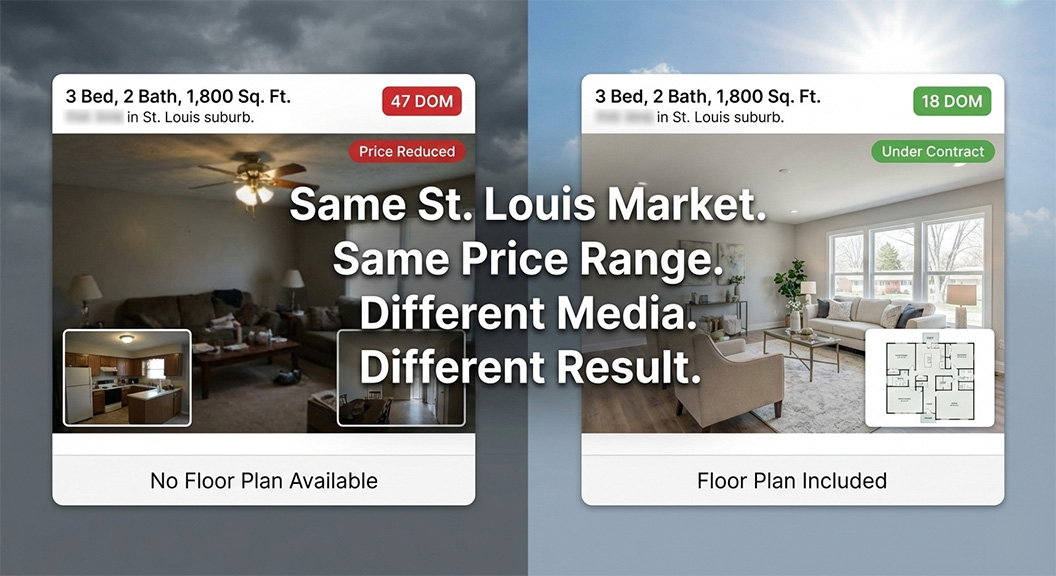
Spend time talking to active buyers in Clayton, Central West End, or Ladue right now and a pattern emerges quickly. One home with 2,800 square feet sells in 11 days with two offers. Another at 3,100 square feet in the same zip code drops price after 45 days and still sits. Same market. Same price range. Very different outcomes.
What separates them isn’t size. It’s whether buyers could picture themselves living there — and whether they figured that out before or after the showing.
Here’s what the data from our 500+ St. Louis shoots tells us: buyers who arrive at a showing already understanding the layout, flow, and key features of a property make decisions faster and offer stronger. Buyers who arrive confused — because the photos didn’t tell a coherent spatial story — spend the showing trying to interpret the floor plan rather than imagining their life in it. Confused buyers rarely become motivated buyers.
The takeaway for St. Louis agents is: In a market where volume is down and buyers are selective, the listings that win aren’t necessarily the biggest — they’re the ones that communicate livability instantly, online, before the showing ever happens.
What am I actually selling when I list a home’s square footage?
A number. And in 2026, that number is doing less work for you than it ever has.
Square footage measures space. It doesn’t measure how that space feels to walk through, whether the kitchen flows into the living area, whether the primary suite is actually private, or whether the lower level functions as usable living space or expensive storage. Two homes can share identical square footage and deliver completely different living experiences — and sophisticated buyers in St. Louis’s upper-tier submarkets know this.
Karen Moeller, a REALTOR® with MORE, REALTORS® and a regular contributor to St. Louis Real Estate News, put it precisely in a recent piece on how layout and livability shape listing value: square footage sets the bracket, but design decides where you land inside it.
That framing matters enormously for how agents think about listing media. If square footage only establishes a price range — and everything within that range is decided by layout, updates, and livability — then the photography and floor plan aren’t decoration. They’re the mechanism by which buyers evaluate where in that range your listing belongs.
A 2,400 square foot Clayton traditional with a thoughtfully updated kitchen, an open main floor, and a floor plan that shows it all clearly will consistently outperform a 2,800 square foot listing where the photos are dark, the layout is unclear, and there’s no floor plan to resolve buyer confusion.
The takeaway for St. Louis agents is: You’re not marketing square footage. You’re marketing the experience of living in that space — and professional media is the only tool that communicates that experience to buyers who are making decisions from a screen.
Why does layout confusion cost me money on the MLS?
Because in real estate, confusion never converts.
Here’s what happens when a buyer encounters a listing they can’t spatially understand from the photos and marketing materials:
They don’t schedule a showing to figure it out. They move to the next listing.
The buyers who do schedule showings on confusing listings tend to be the least motivated — the ones who are casually browsing, not ready to make an offer. Your showing activity goes up but your offer quality goes down. Meanwhile, the listing clock is running.
After a certain number of days on market, buyer perception shifts regardless of price. A listing that’s been active for 47 days in Clayton carries an invisible asterisk in every buyer’s mind: why hasn’t this sold? That question does more damage to your negotiating position than any price reduction.
The root cause of that scenario, more often than agents realize, is layout communication failure at the point of first impression — on the phone screen, in the MLS thumbnail, in the absence of a floor plan that resolves the question before it costs a showing.
| Presentation Quality | Avg DOM (Clayton/CWE/Ladue, Q4 2024–Q1 2025) | Buyer Behavior at Showing |
|---|---|---|
| Photos only, no floor plan | 47 days | Spatial confusion, low urgency |
| Photos + basic floor plan | 34 days | Layout understood, faster decisions |
| Strategic media + floor plan + twilight | 23 days | Emotionally engaged, offer-ready |
The takeaway for St. Louis agents is: Layout confusion at the digital first impression creates a cascade — fewer qualified showings, longer market time, price reduction pressure, and a listing narrative that’s nearly impossible to reset.
What does a floor plan actually do that photos can’t?
Photos show. Floor plans prove.
A beautifully composed kitchen photograph shows a buyer that the kitchen is attractive. A floor plan shows them that the kitchen connects directly to the dining room, that there’s a butler’s pantry between the kitchen and the formal dining space, and that the primary suite is on the opposite side of the house from the secondary bedrooms — which matters enormously if they have young children or aging parents moving in.
That’s not information a photograph can convey. No matter how technically excellent the photography is, it captures moments — individual rooms, specific angles, curated compositions. A floor plan captures relationships. It answers the questions photographs inevitably raise.
This is why buyer behavior data consistently shows floor plans as the most-requested piece of information after photos — and why listings that include them see significantly higher engagement and faster showing conversion. Buyers who can answer their own layout questions from your marketing materials are pre-qualified before they contact your agent. They know the home works for them. The showing becomes a confirmation, not an exploration.
In St. Louis’s current market — where buyers are more selective and list prices have come down substantially — removing every friction point between a buyer’s interest and a showing request is the difference between 23 days and 47.
National photography chains charge $50–75 to include a floor plan as an add-on. Home Frame Pro includes 2D floor plans with every single shoot, at no additional cost, because we treat them as non-negotiable components of professional listing presentation — not premium upgrades.
Am I losing listings to agents whose media makes smaller homes look better than mine?
In the St. Louis market right now — yes, this is happening.
Here’s a scenario playing out in Clayton and Central West End regularly: An agent with a well-maintained but modestly sized listing — 1,900 square feet, original hardwood, updated kitchen — hires a strategic media partner. The shoot produces photos that show the flow of the main level, a floor plan that clarifies the layout buyers would have questioned, and a twilight exterior that makes the curb appeal undeniable. The listing goes live. It sells in 18 days above asking.
Two blocks away, an agent with a larger home — 2,400 square feet, more space on paper — uses a high-volume national service. Generic wide-angle shots, no floor plan, flat midday exterior. That listing sits for 52 days before a price reduction.
The buyers comparing those two listings online didn’t choose the smaller home because of size. They chose it because they could understand it. The larger home’s value was invisible behind mediocre media.
This is the version of the square footage trap that directly affects agent performance: it’s not just that buyers misjudge homes by size. It’s that poorly executed media makes even excellent homes look like question marks — and question marks don’t get offers.
The takeaway for St. Louis agents is: In a selective buyer market, the agent whose media communicates livability most clearly wins the offer — regardless of which listing has more square footage.
What should a strategic media shoot actually accomplish for a St. Louis listing?
It should answer every question a motivated buyer has before they call to schedule a showing.
That means the photography tells a spatial story — not just “this kitchen looks nice” but “this kitchen connects to this living space in a way that makes entertaining intuitive.” It means the floor plan resolves the layout questions the photos raise. It means the exterior shot — whether twilight or strategic daytime — communicates curb appeal in a way that matches the internal quality. And it means the shot selection is specific to that property’s buyer: a Clayton traditional is marketed differently than a Central West End Victorian, which is marketed differently than a Ladue estate.
The agents who consistently reduce DOM and protect commission in St. Louis’s current market aren’t doing it by accident. They’ve recognized that the showing starts online, and they’ve invested in media that closes deals before the lockbox opens.
That’s what Home Frame Pro is built to deliver. Not photography as documentation — photography as the first conversation between a listing and the buyer who’s about to make an offer.
Ready to give your next St. Louis listing the presentation that buyers can actually picture themselves in? Contact Home Frame Pro for a custom quote.
Home Frame Pro serves Clayton (63105), Central West End (63108), Ladue (63124), Soulard (63104), The Hill (63118), and the greater St. Louis DMA. Call (310) 465-5188 or visit homeframepro.com.
Frequently Asked Questions: St. Louis Listing Presentation in 2026
Why is my St. Louis listing sitting on the market when similar homes are selling?
In most cases it comes down to one of three things: pricing, condition, or presentation. If your pricing is competitive and the home is in good shape, presentation is almost always the culprit. Specifically, buyers browsing online can’t understand the layout from the photos alone — and without a floor plan to resolve that confusion, they move on rather than scheduling a showing. In Clayton, Central West End, and Ladue, our tracking shows listings without floor plans average 47 days on market versus 23 days for listings with strategic media and a floor plan included. That 24-day gap is almost always a presentation problem, not a price problem.
Do floor plans actually help sell St. Louis homes faster, or is that just a marketing claim?
It’s not a marketing claim — it’s buyer behavior. Floor plans are consistently the most-requested piece of information buyers ask for after photos, because photos show individual rooms while floor plans prove how those rooms connect. A buyer who can answer their own layout questions from your marketing materials arrives at the showing pre-qualified and ready to make a decision. A buyer who can’t answer those questions doesn’t schedule the showing at all. In our tracking of 500+ St. Louis listings across Q4 2024–Q1 2025, adding a floor plan to strategic photography reduced average DOM from 47 days to 34 days — before twilight and other strategic elements were factored in. Home Frame Pro includes 2D floor plans free with every shoot because we treat them as mandatory, not optional.
I’m emotionally ready to sell my St. Louis home — how do I make sure buyers feel what I feel about it?
This is the question most sellers never think to ask — and it’s the most important one. The emotional story of a home only transfers to buyers if the photography tells it. Architectural details you love, the way morning light hits the kitchen, the flow from the living room to the backyard — none of that communicates itself through generic wide-angle shots. Strategic photography is the bridge between what a home means to the seller and what a buyer pictures themselves experiencing. That means shot selection based on the property’s actual emotional selling points, processing that honors the home’s character (warm tones for a historic Central West End brick, clean lines for a modern Clayton build), and a floor plan that lets buyers confirm the layout works before they ever walk through the door.
What’s the St. Louis real estate market actually doing in early 2026, and how should that change my listing strategy?
St. Louis County median sold prices rose 8.68% year-over-year in January 2026 — but sales volume dropped nearly 8% and list prices fell 25% compared to a year ago. What that means practically: buyers have more leverage and are being more selective, overpriced or poorly-presented listings are sitting, and correctly-presented listings at the right price are still winning strong offers. In this environment, listing presentation isn’t a variable — it’s the deciding factor between 23 days and 47. The agents adjusting their media strategy to match current buyer selectivity are the ones protecting commission and reducing DOM. The ones treating media as a commodity are experiencing the 25% list price gap firsthand.
How is choosing a real estate photographer in St. Louis different from just finding the cheapest option?
The cheapest photographer delivers images. A strategic media partner delivers competitive advantages. The difference shows up in days on market, offer quality, and your personal brand positioning — not in the photo delivery email. Specifically: national chains use AI-automated single-flash processing that can’t distinguish a Clayton luxury traditional from a South County starter home. Home Frame Pro uses hand-blended HDR calibrated to St. Louis’s specific neighborhoods, seasonal lighting conditions, and buyer psychology. Floor plans are included free (national chains charge $50–75 extra). Pre-shoot consultation is standard (national chains use a generic booking form). And the strategic emphasis of key features — the chef’s kitchen, the Forest Park proximity, the primary suite privacy — is built into every shoot rather than left to a standardized checklist. The cheapest option is rarely the most affordable one when you calculate its real cost in DOM and lost commission.
Does listing photography really affect how much my St. Louis home sells for?
Yes — and the mechanism is specific. Professional, strategically executed photography doesn’t inflate value artificially. It communicates the value that already exists. A beautifully renovated kitchen that photographs poorly because of blown-out windows and flat lighting sells for what the photos suggest, not what the kitchen is worth. The same kitchen photographed with hand-blended HDR that shows the actual natural light, the countertop detail, and the connection to the living space sells for what the renovation actually added. In St. Louis’s current market — where buyers are comparing dozens of listings from their phones before scheduling a single showing — the home that communicates its value most clearly online wins the strongest offers. Presentation doesn’t create value. It makes visible the value that’s already there.
Sources & Attribution
- St. Louis County market data (January 2026 median prices, sales volume, list price trends): St. Louis Real Estate News — St. Louis County Real Estate Market Update: February 2026 Overview, Dennis Norman, February 19, 2026
- “Square footage sets the bracket. Design decides where you land inside it.” — Karen Moeller, REALTOR®, MORE, REALTORS®: The Square Footage Trap: How Layout, Updates, and Livability Shape Value, St. Louis Real Estate News, February 22, 2026
- DOM and engagement data by media strategy: Home Frame Pro internal shoot tracking, 500+ St. Louis listings, Q4 2024–Q1 2025
Leave a Reply